
Punnett Square Generator (Genetics) – Predict the Genetic Inheritance of Your Offspring
Punnett Square Generator
Your Visual Tool for Understanding Genetic Probabilities
Wondering about the possible genetic combinations of offspring? Our Punnett Square Generator allows you to visualize and predict the probability of inheriting specific alleles for genetic traits based on the parents' genotypes. Get a clear representation of the possible genetic combinations and their probabilities.
- ✅ Clear visualization – See all possible allele combinations graphically.
- ✅ Probability prediction – Determines the probability of each genotype in the offspring.
- ✅ Educational tool – Ideal for learning the basic principles of Mendelian genetics.
Use our generator now and explore the possibilities of genetic inheritance.
Example of a Punnett Square Generated with the Calculator
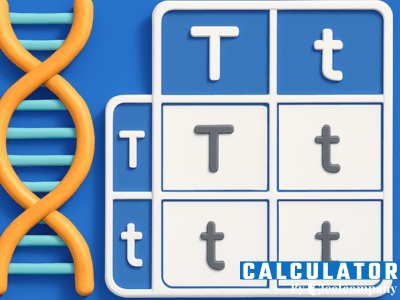
Imagine we're crossing two pea plants. The mother plant is heterozygous for height (Tt), and the father is also heterozygous (Tt). We want to predict the possible heights of their offspring.
Applying the Formula (Combination of Alleles):
|
T |
t |
|
|
T |
TT |
Tt |
|
t |
Tt |
tt |
📊 Result: The Punnett square shows the four possible genetic combinations of offspring: TT (homozygous dominant), Tt (heterozygous), and tt (homozygous recessive), each with probability 25%. Phenotypically, the offspring will be tall (TT and Tt) and short (tt), assuming complete dominance of the T (height) allele.
📢 Visualize the genetic combinations of offspring with our Punnett square generator.
How Does Our Punnett Square Generator Work?
The process is simple:
Step 1: Entering Parental Genotypes
- 🧬 Maternal Genotype: Enter the alleles for the mother's genetic trait (e.g., Tt, AA, bb). Why is this important? It represents the mother's genetic contribution.
- ♂️ Paternal Genotype: Enter alleles for the same genetic trait as the father (e.g., Tt, AA, bb). Why is this important? It represents the father's genetic contribution.
Step 2: Generating the Punnett Square
- ⚙️ The calculator creates a matrix where the alleles of one parent are placed on top and those of the other parent on the side.
- Each cell in the table represents a possible combination of alleles that offspring can inherit.
Step 3: Viewing Offspring Genotypes
- ✅ Look at all the possible genetic combinations of offspring in the cells of the table.
- 💡 Use the table to determine the probability of each genotype and phenotype in the offspring, based on the principles of Mendelian inheritance.
📢 Need to understand the inheritance of multiple traits? 🧐 Try our generator to analyze dihybrid and more complex crosses.
This is only for entrepreneurs, business owners and freelancers.
🚀 If you need to launch your website, SaaS or online store, visit NippyLaunch.com.
📈 If you need to do digital advertising and marketing for your company, visit CleefCompany.com.
What is the Punnett Square Generator (Genetics)?
The Punnett Square Generator is an online tool that creates a diagram used in genetics to predict the possible allele combinations for a genetic trait in offspring, based on the known genotypes of the parents. The Punnett square organizes the alleles of each parent along the axes and shows all possible combinations when these alleles unite during fertilization. It allows the calculation of genotypic and phenotypic probabilities of the offspring.
This tool is essential in teaching Mendelian genetics and in genetic research to analyze inheritance patterns.
👉 Visualize the probabilities of genetic inheritance intuitively with our Punnett square generator.
Recommended books to delve deeper into genetics and inheritance
Explore these readings that will help you better understand the principles of genetics and the mechanisms of inheritance.
1️⃣ “Genetics for Beginners” by Steve Jones and Borin Van Loon: An accessible and visually appealing introduction to the basics of genetics.
2️⃣ “Principles of Genetics” by D. Peter Snustad and Michael J. Simmons: A comprehensive undergraduate textbook covering the fundamentals of Mendelian and molecular genetics.
3️⃣ “The Selfish Gene” by Richard Dawkins: Explore evolution from the perspective of genes and inheritance.
Why Use Our Punnett Square Generator?
- ✅ Visual Clarity – The Punnett square offers an easy-to-understand graphic representation.
- ✅ Probability prediction – Allows you to calculate the genotypic probabilities of the offspring.
- ✅ Educational tool – Facilitates learning the concepts of alleles, genotypes, and phenotypes.
- ✅ Efficiency – Generate the chart quickly without having to draw it manually.
Avoid These Common Mistakes When Using the Punnett Square Generator
- 🚫 Incorrectly entering the parents' genotypes.
- 🚫 Not understanding the difference between genotype (combination of alleles) and phenotype (observable characteristic).
- 🚫 Assuming complete dominance when inheritance may be incomplete or codominant.
Use our generator to visualize genetic inheritance accurately and avoid common analysis errors.
Comparison: Punnett Square Generator vs. Traditional Methods
Why use our generator instead of drawing Punnett squares manually?
- ✅ Speed – Generates the frame instantly, especially useful for complex crosses.
- ✅ Accuracy – Reduces the possibility of errors when combining alleles manually.
- ✅ Ease – Intuitive interface for entering parental genotypes.
- ✅ Convenience – Available online anytime for your genetic testing.
Explore the possibilities of genetic inheritance efficiently with our specialized tool.
Frequently Asked Questions about the Punnett Square Generator (Genetics)
What do the letters in the Punnett square represent?
Letters represent the alleles of a specific gene. Capital letters usually indicate dominant alleles, and lowercase letters indicate recessive alleles.
How do you interpret the results of the Punnett square?
Each cell in the table represents a possible combination of alleles that offspring can inherit, and the proportion of each genotype in the table indicates the probability of that combination occurring.
Can I use this generator to analyze the inheritance of more than one feature at a time?
This generator is primarily designed for monohybrid crosses (single trait). To analyze the inheritance of two or more traits (dihybrid or polyhybrid crosses), larger Punnett squares or specialized tools would be required.
What is a homozygous and heterozygous genotype?
A homozygous genotype has two identical alleles for a trait (e.g. TT or tt), while a heterozygous genotype has two different alleles (e.g. Tt).
What is a phenotype?
The phenotype is the physical expression or observable characteristic of an organism, determined by its genotype and environmental factors.
What is dominance and recessiveness?
A dominant allele is expressed in the phenotype whether it is present in one copy (heterozygous) or in two copies (homozygous dominant). A recessive allele is expressed in the phenotype only if it is present in two copies (homozygous recessive).
Does the calculator consider gene linkage or crossing over?
No, this basic Punnett square generator assumes independent segregation of alleles, as in simple Mendelian inheritance. It doesn't consider more complex phenomena such as gene linkage or crossing over.
Can I use symbols other than letters to represent alleles?
Generally, yes. The calculator is based on the symbols you enter for the parental genotypes.
Is this tool useful for biology students?
Absolutely. It's a fundamental tool for learning and visualizing the principles of genetic inheritance.
What happens if one parent has multiple alleles for a trait?
For situations with multiple alleles (more than two possible alleles for a gene), the Punnett square would be adapted to include all possible combinations.
Still have questions? Use our generator and explore the fascinating possibilities of genetic inheritance.
 English
  Spanish